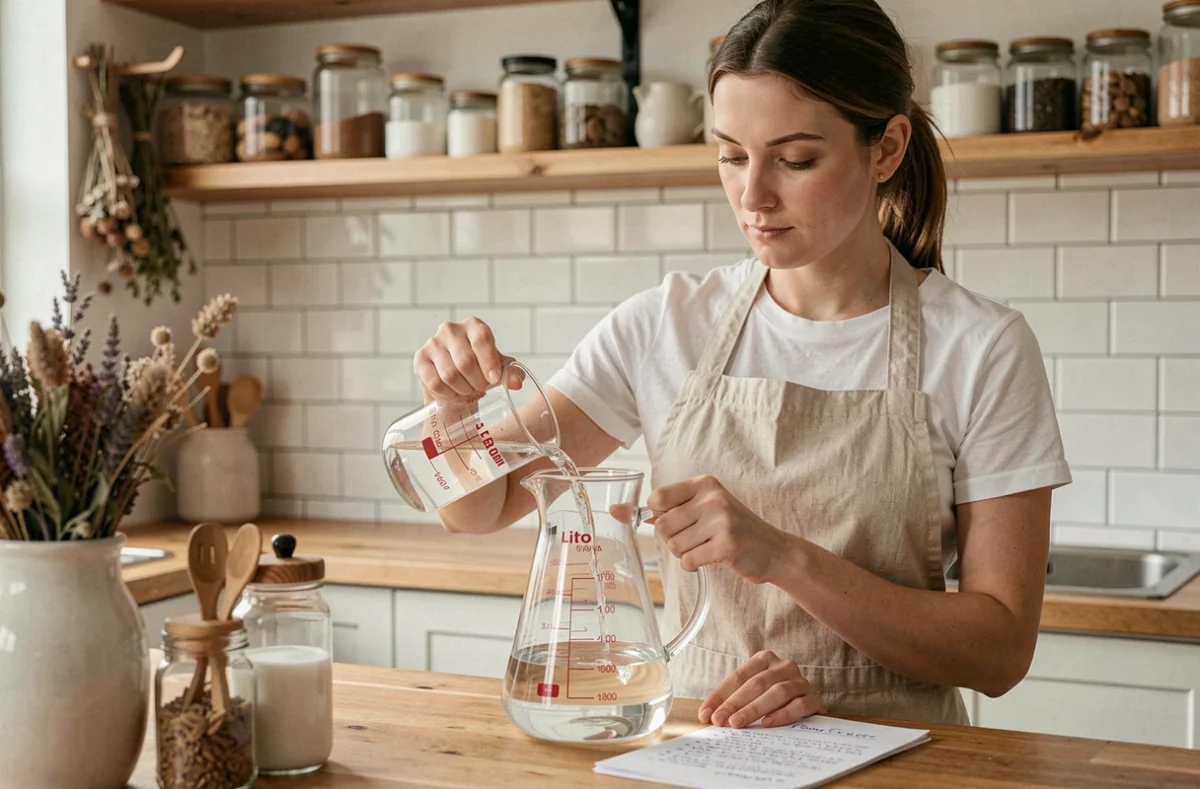
Converting 300 ml to liters means dividing by 1,000, which equals 0.3 liters. The calculation is straightforward, yet it only addresses part of the problem posed by a recipe.
Knowing that 300 ml is equivalent to 0.3 L says nothing about how to measure this volume accurately, nor about the behavior of the liquid in a container. In cooking, and even more so in baking, it is the measurement method that determines the final result, not the chosen unit.
Measuring 300 ml without a measuring cup: scales, spoons, and everyday glasses
Most home kitchens do not always have a graduated measuring cup on hand. The question then becomes practical: how to obtain 300 ml of liquid with what is available in the cupboard?
The conversion of 300 ml to liters provides a theoretical reference, but accuracy depends on the tool used for pouring or weighing.
Using a kitchen scale
For water, 300 ml corresponds to 300 g. The density of water makes this equivalence reliable. Simply place a container on the scale, tare it, and then pour until reaching 300 g. For water, weighing is a better substitute for the measuring cup.
However, this correspondence no longer holds when changing liquids. Oil is less dense than water: 300 ml of oil weighs significantly less than 300 g. Honey or a thick syrup, on the other hand, weigh more for the same volume. Thus, converting 300 ml to 0.3 liters does not automatically imply a weight of 300 g.
Using tablespoons
A tablespoon holds about 15 ml. To reach 300 ml, you need to count 20 level tablespoons. This method is slow, but it remains functional for fluid liquids like water, milk, or broth.
- Level tablespoon: about 15 ml, or 20 tablespoons for 300 ml
- Level teaspoon: about 5 ml, or 60 teaspoons (not practical, reserved for fine adjustments)
- Standard mustard glass: about 20 cl, or one and a half glasses to reach 30 cl
- Coffee cup: about 10 cl, or three cups to obtain 300 ml
These equivalences remain approximations. The margin of error increases with the number of successive measurements, each spoon adding a slight discrepancy.
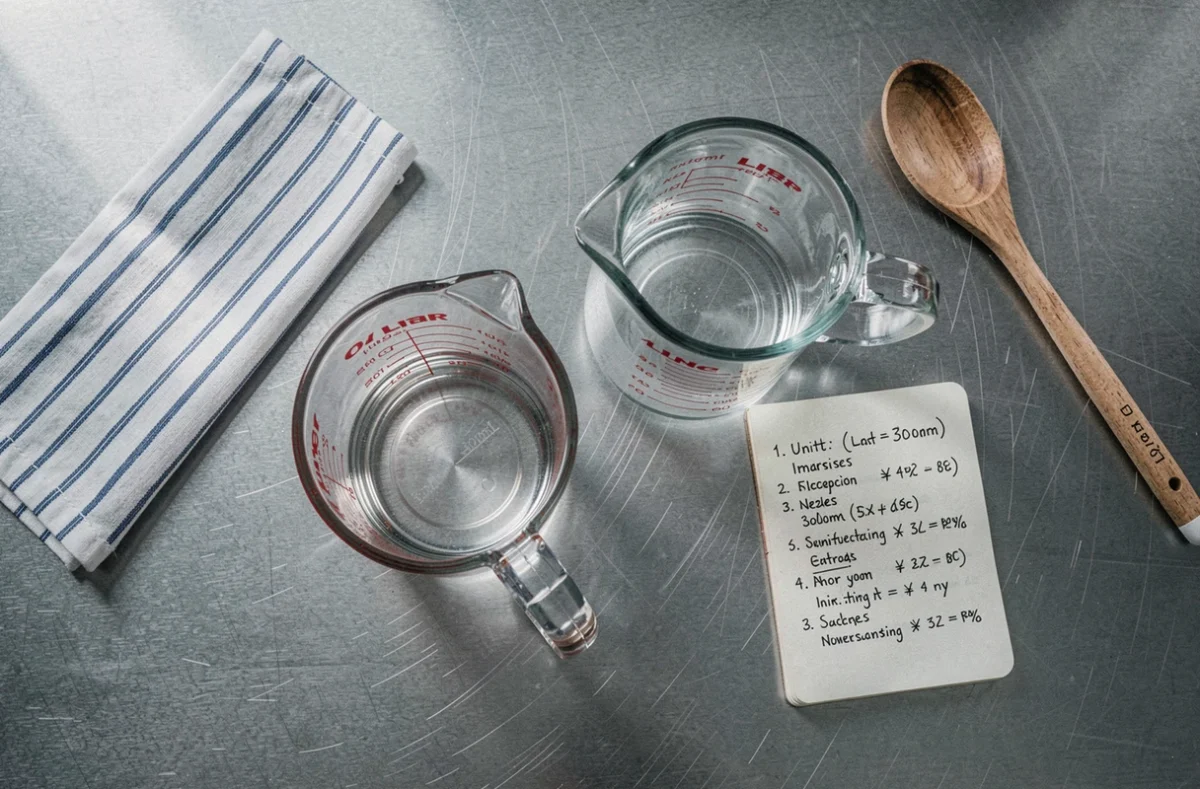
Why the milliliters-to-liters conversion is not enough in baking
A soup or stew can tolerate a few dozen milliliters of variation without noticeable consequences. Baking does not forgive so easily. A variation in liquid alters the hydration, texture, and rise of a dough.
Take a cake batter that requires 300 ml of milk. If the measurement is taken in a non-graduated glass, read approximately, the discrepancy can reach 10 to 15% of the targeted volume. In a calibrated recipe, this excess or lack of liquid changes the consistency of the batter and, ultimately, the crumb of the baked product.
The meniscus trap and reading at an angle
When using a measuring cup, the surface of a liquid like water or milk forms a concave curve called a meniscus. The best practice is to place the container on a flat surface and read the level at eye level, at the bottom of the meniscus. Holding the glass in the air or looking at it from an angle distorts the reading.
This detail may seem trivial, but it represents the primary source of error in volume measurements in home cooking. Converting mentally 300 ml to 0.3 L or 30 cl is pointless if the reading itself is approximate.
Viscous liquids: when the measured volume does not correspond to the poured volume
Honey, olive oil, syrups, or heavy cream pose a problem that fluid liquids do not have. These products adhere to the walls of the measuring container. What remains stuck in the measuring cup never makes it into the mixing bowl.
For a viscous liquid, weighing is more reproducible than volumetric measurement. By weighing directly in the preparation container, you eliminate losses related to transfer. You need to know the approximate density of the liquid in question or rely on weight indications sometimes found on packaging.
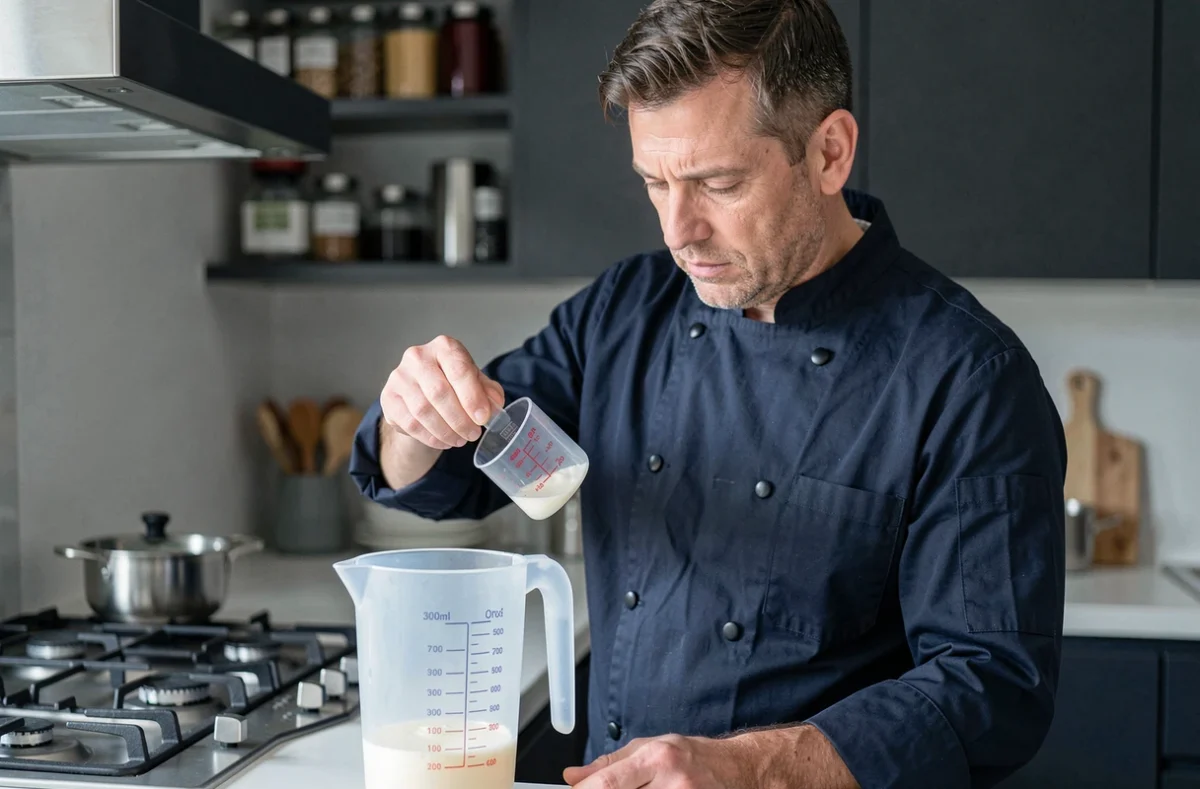
Adapting the method to the type of ingredient
For 300 ml of water or broth, a properly read measuring cup is sufficient. For 300 ml of honey, the scale provides a much more reliable result. This distinction does not appear in a simple conversion table, but it changes the outcome of a recipe.
- Fluid liquids (water, milk, juice): the measuring cup works well if the reading is done at eye level on a flat surface
- Fatty liquids (oil, melted butter): the measuring cup remains usable, but weighing avoids residues on the walls
- Viscous liquids (honey, syrup, heavy cream): weighing is recommended to obtain the actual amount in the preparation
Quick conversion table around 300 ml
For the most common conversions near 300 ml, a simple reference helps avoid interrupting your recipe.
| Volume in ml | In cl | In liters | Practical equivalent |
|---|---|---|---|
| 150 ml | 15 cl | 0.15 L | One mustard glass minus a quarter |
| 200 ml | 20 cl | 0.2 L | One mustard glass |
| 250 ml | 25 cl | 0.25 L | A quarter of a liter |
| 300 ml | 30 cl | 0.3 L | One and a half mustard glasses |
| 500 ml | 50 cl | 0.5 L | Half a liter |
300 ml is equivalent to 30 cl or 0.3 liters, regardless of the liquid. The transition from one unit to another relies on multiples of 10: divide by 10 to go from ml to cl, divide by 1,000 to go from ml to liters.
The conversion itself poses no mathematical difficulty. What makes the difference between a successful recipe and a failed one is how this volume is measured, with what tool, what type of liquid, and at what height the graduation is read. A correct number on paper does not guarantee a correct number in the mixing bowl.