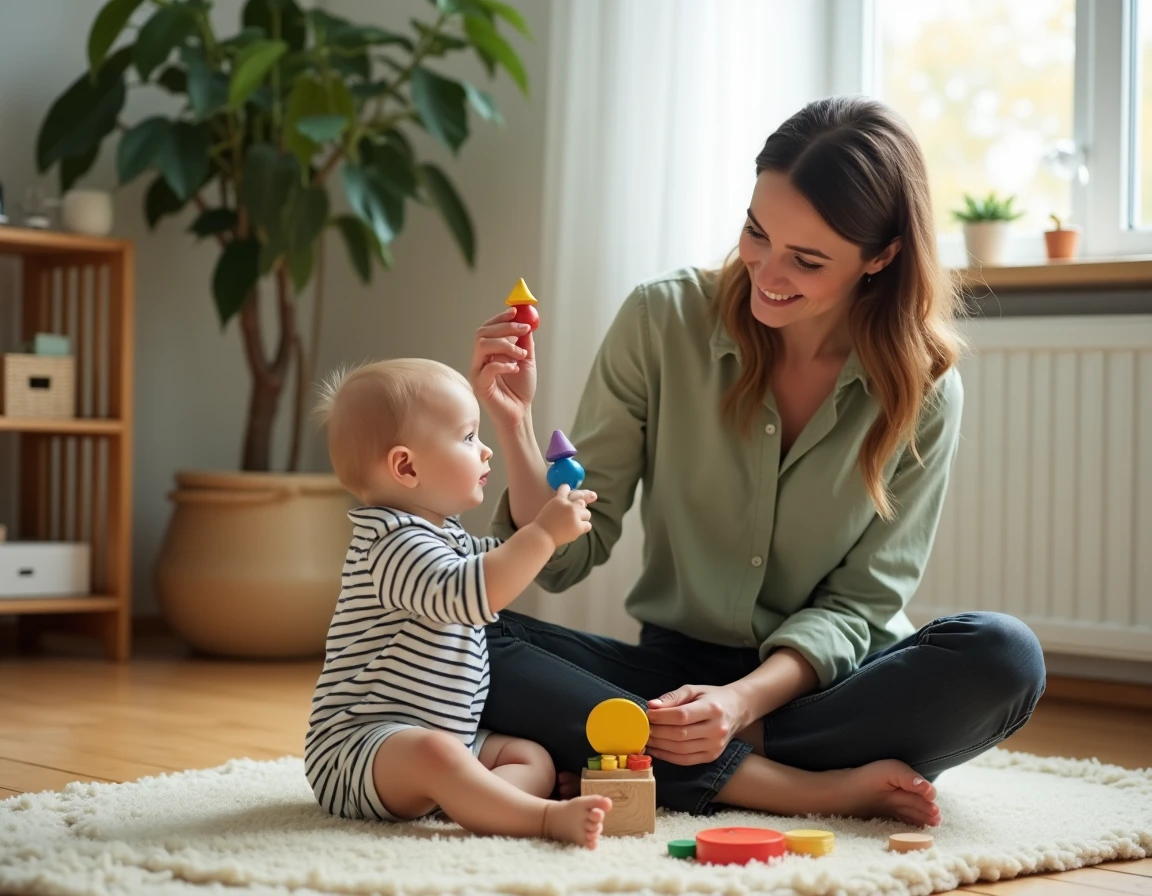
A two-year-old child methodically emptying the Tupperware drawer while you prepare dinner: this is a scene of awakening that costs nothing and was not planned by anyone. Supporting daily awakening relies less on accumulating activities and more on the quality of ordinary moments. Transferring, stacking, observing an ant on the balcony—these actions nourish curiosity, language, and fine motor skills much more effectively than a packed schedule of creative workshops.
Daily tasks and child awakening: the most underestimated area

In active pedagogy nurseries inspired by Reggio Emilia or Loczy, one observation frequently arises: involving the child in real daily tasks (folding a towel, transferring pasta, wiping a table, watering plants) fosters self-esteem, language, and concentration more than many activities prepared by adults. The condition: give them enough time and room for error.
Specifically, we can start with three simple actions during mealtime. Let the child pour water into their glass with a small pitcher. Give them a sponge to clean their spot. Ask them to place the napkins on the table, even if they need four and they put six.
Complementary ideas can be found in the child section on Le Petit Blog de Maman, which addresses these practical situations from various angles depending on age. The challenge remains the same: a child who participates in household life develops vocabulary related to action (“I cut,” “it’s hot,” “more”) and hand-eye coordination that educational games alone cannot build.
Balance between stimulation and empty time: measuring awakening without overloading

We tend to fill every slot of the day with a structured activity. Painting in the morning, modeling clay after nap time, nursery rhymes before bath time. The schedule reassures the adult, but the child doesn’t always need it.
Pediatricians and child psychiatrists now recommend setting aside screen-free and unstructured time to allow for creative boredom. A child who is bored for five minutes often ends up inventing a game, manipulating an unexpected object, or engaging in silent observation. This “empty” time is not wasted time.
Identifying signs of overstimulation
A child flitting from one game to another without settling down, constantly asking for “more,” or getting upset when an activity stops sends a signal. They may need less, not more.
- Offer two or three accessible toys at a time, not an entire box emptied on the floor, to encourage concentration on a single object
- Alternate a guided moment (nursery rhyme, reading, building game together) with a free moment where the adult remains available without directing
- Observe before intervening: if the child is going in circles, wait a few minutes before suggesting something
Feedback on this point varies among children and ages, but the underlying principle holds: a rhythm that alternates stimulation and rest produces more lasting awakening than a day saturated with activities.
Sensory games at home: what really works by age
Everywhere you read lists of “50 Montessori activities to do at home.” The problem is that half require specific materials and the other half is suitable for a specific age. It’s better to start with what you have in the cupboards.
Before two years: textures and containers
A bin with semolina, wooden spoons, and cups of different sizes. It’s a classic because it works. The child explores filling, emptying, and the sound of the grain falling. The repetition of the action builds fine motor skills long before they can hold a pencil.
You can also offer a discovery basket with everyday objects of varied textures: a soft brush, a piece of fabric, a rubber ball, a cork. The adult names each object, each sensation. Vocabulary comes through touch.
Between two and four years: imitation and sorting games
At this age, the child enters symbolic play. They pretend to cook, care for a stuffed animal, or make phone calls. These imitation games do not require a 150-euro wooden kitchen. A cardboard box, a spoon, and a bit of imagination are enough.
Sorting by color or size (buttons, caps, pairs of socks) develops logic and categorical language. We name, compare, and classify. Sorting real objects anchors logical thinking in the concrete.
Nursery rhymes and foreign languages: an underutilized lever for linguistic awakening
Several longitudinal studies in early childhood show that the variety of languages heard daily is associated with better attention and cognitive flexibility in young children, regardless of socio-economic status. Bilingual family, nanny speaking another language, multilingual nursery: contexts vary, but the mechanism remains the same.
Specifically, integrating nursery rhymes in multiple languages into the daily routine requires no particular language skills. Audio versions of traditional songs in Spanish, Arabic, English, or Portuguese can be found, and the child absorbs the musicality, phonemes, and rhythm effortlessly.
- Sing a nursery rhyme in another language during bath time or changing, even without mastering perfect pronunciation
- Associate a language with a time of day (an Italian lullaby in the evening, a song in English in the morning)
- Read a bilingual book while pointing to the pictures, without trying to translate every word
A child’s ear develops in the early years, and this window gradually closes. Taking advantage of daily life to introduce varied sounds remains the most accessible approach.
A child’s awakening is not measured by the number of activities checked off in the week. Folding a towel, a bin of semolina, a nursery rhyme in Portuguese, and twenty minutes of boredom often count for more than a schedule filled with workshops. The most reliable filter remains observation: when the child focuses, manipulates, repeats an action, or invents a scenario, awakening is already underway.