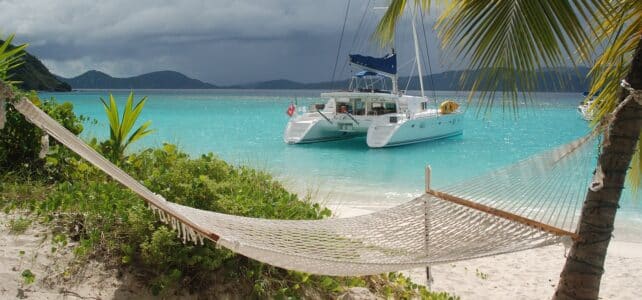
The catamaran, this two-hulled boat that glides gracefully over the waters, is a fascinating invention. But why is it called that? Let’s dissect together the origin of this term that resonates so harmoniously in our ears.
Origin of the word catamaran
The word catamaran has exotic roots that date back a long time. It comes from the Tamil language, spoken primarily in South India and Sri Lanka. In Tamil, kattumaram literally means tied boat. This name originates from the way the parallel hulls of the catamaran are connected by a rigid structure, giving it its legendary stability.
The first traces of catamarans
The first documented uses of catamarans date back thousands of years in the coastal regions of India and Sri Lanka. Local fishermen quickly understood the advantages of this type of boat for navigating the rough waters of the Indian Ocean. Thanks to its unique design, the catamaran could face the waves with disconcerting ease, ensuring the safety of its crew.
Evolution and popularity of the catamaran
Over the centuries, the catamaran has conquered other horizons and adapted to new uses. From a traditional fishing vessel, it has become a fast and high-performance racing sailboat, attracting many sailing enthusiasts around the world. Today, the catamaran lagoon is synonymous with luxury and comfort, offering unforgettable cruises aboard these magnificent yachts.
The advantages of the catamaran
Why is the catamaran so popular today? Its exceptional stability at sea is certainly the main reason. Unlike a monohull, a catamaran offers a solid footing on the water, thus reducing the risk of seasickness for passengers. Moreover, the increased width of its hulls allows for spacious living areas on board, ideal for family or friends’ cruises.
Finally, the top speed of a catamaran is often greater than that of a monohull, providing thrilling experiences for sailing enthusiasts looking to push the limits of navigation.